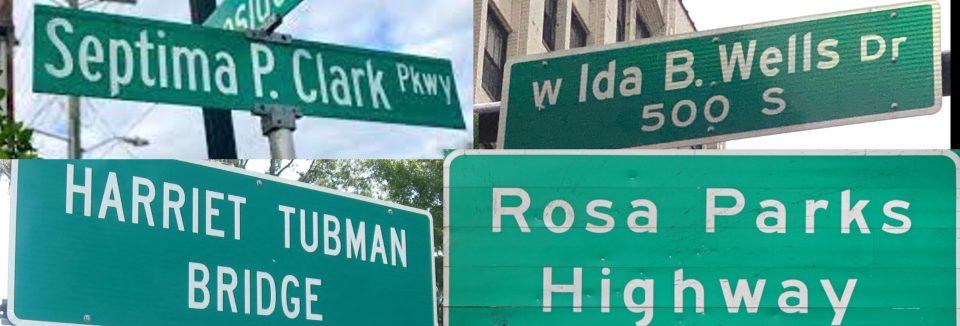
Co-Directed by Derek Alderman and Seth Kannarr
The goal of I-NAME (Interventions in Naming America and Mobilizing for Equality) is to create a workspace for scholars, administrators, planners, activists, teachers and students to generate intellectual, policy, and educational innovations that can advance public debate and decisions about the pressing issue of commemorative place name reform.
The hope is to encourage communities to reflect critically and honestly on the racialized and gendered histories behind named places, to recast place naming as a public participatory and regenerative process, and to move toward a more inclusive commemorative place name landscape. The initiative responds to America’s ongoing place (re)naming conflicts and the need for actionable knowledge to address inequalities in naming place and claiming the past–particularly from the perspective and experiences of historically marginalized social actors and groups.
America’s Place Name Wars
 Many of the nation’s streets, parks, and university campus buildings bear the names of Confederate generals, Ku Klux Klan leaders, segregationist politicians, and defenders of slavery. In the post-Charleston and post-Charlottesville era, American communities are now engaged in highly charged debates, if not cultural wars, over whether to remove these public symbols. Fueled by the Black Lives Matter Movement and older traditions of commemorative reform, activists argue passionately for name changes, not as mere political correctness, but to address the larger atmospheres of inequality and intimidation these named spaces communicate to and create for people of color.
These calls for name change have evoked wide-ranging responses. Many citizens and officials strongly resist losing longtime names, to the point of passing laws to keep them in place. Some decide to erase offensive monikers simply to curtail further controversy, in effect changing the political subject rather than engage in the difficult work of (ad)dressing the wounds of past and current racial discrimination. In a much smaller proportion of cases, communities use the de-commemoration of racist historical figures to create spaces to actively honor by, name, the often marginalized historical contributions, struggles, and worldviews of African Americans.
America’s place names are embedded within the ordinary geographies of people identifying, navigating, and experiencing their communities. They are also memorials that cast critical light on the everydayness of racism, the transmission of racial power over generations, and the reparative potential of renaming. Our named spaces, although poorly understood, are important, contested narratives in addressing the legacies of White supremacy and building anti-racist public spaces.
Need for Actionable Knowledge
Students of American politics and society have traditionally treated place names (also called toponyms) as if they exist beyond struggles over civil and cultural rights. The study of African American commemorative politics has grown significantly in the past few decades, but research on place naming is limited. Even within the recent “critical turn” in toponymic studies, we see scant work on named spaces in the context of racism and racial justice.
My past research over several years demonstrates that the authority to name places is often unfairly distributed across racial lines and can thus contribute to larger patterns of social inequality. Commemorative toponyms can participate in the creation of a discriminatory built environment that serves the histories and worldviews of certain social actors and groups while inflicting symbolic violence on the identities, memories and well-being of others. Racial inequality has shaped US place names since early settlement, but I am also uncovering a long history of African Americans and other marginalized populations resisting and even seizing control of naming to demand greater recognition within the public sphere.
Many citizens and pubic officials (as well as scholars) engaged in America’s place name conflicts lack a full understanding of the cultural and political significance of toponyms, particularly with respect to the African American Freedom Struggle and the extent to which place names have been deployed as technologies of power. The I-NAME project responds to the need for an actionable body of knowledge that can inform these community debates about race, memory, and inequality. Such knowledge is critical to the functioning of the American democracy and fully applying inclusionary principles and racial reconciliation to ongoing toponymic controversies.
Online Data and Education Resources on the Geography of Street/Place Names.
- America is caught in a name game where place names become political tools (article in The Conversation, 2024)
- Why returning the name Kuwohi to the Great Smoky Mountains matters (article in The Conversation, 2024)
- Street Names Search Apps (STNAMES LAB)–visualize the spatial distribution of street names in North America, Europe and Spain and download the underlying dataset.
- Offensive names dot the American street map − a new app provides a way to track them (article in The Conversation, 2024)
- Advancing Geographies of Justice by Removing Offensive Place Names (video of webinar, California Geographic Alliance, 2024)
I-NAME Related Policy Contribution
- Lead co-author of Place Name Reconciliation: Guiding Visions and Principles (with members of the Processes and Principles Subcommittee of the Federal Advisory Place Name Reconciliation Committee, US Department of Interior, 2022-2025). The document, unanimously adopted by the Advisory Committee, is a policy framework that articulates a reparative and participatory approach to reforming derogatory place names in the United States. It outlines core principles—such as historical reckoning, public engagement, research-driven audits, and educational outreach—to guide governmental agencies, community organizations, and citizens in replacing harmful place names with ones that honor marginalized histories and foster social healing. It is intended to advance local and national conversations about how to approach place names as public symbols and responsible toponymic reform (can be found at: https://www.nps.gov/orgs/1892/upload/Place-Name-Reconciliation-Principles.pdf ).
I-NAME Related Public & Media Engagement
- 2025: Contributed research on MLK Streets, a video interview, and pro-bono consultation for an online educational module entitled “King Blvd: From Dreams to Reality” to accompany and complement a drama/comedy film directed and produced by Earl Hardy. The purpose of the module is to help viewers/students understand the political obstacles that face naming streets for Dr. King in America, how those obstacles shape where King (on what kinds of streets) is honored, and how the public can get involved in improving MLK streets in their communities.
- 2024: Provided data and other background information on the national and international profile of streets named for Martin Luther King to NAACP Boulder County, Colorado. Information was provided to support a successful state resolution to rename the road in Boulder, Colorado, in honor of King. Information also supports preparations for a city-wide celebration and promotion of the road naming.
- 2023: Provided unpaid consultation/invited informational interview to The Place Justice Project, a statewide truth-seeking and historical recovery initiative of Maine’s Permanent Commission on the Status of Racial, Indigenous, and Tribal Populations. Consultation and assistance focused on translating the latest innovations in critical toponymic studies to American place name reform and the ways in which Black communities are absent from, harmed by, misrepresented & marginalized in the prevailing narratives inscribed into places as built environments and public spaces.
- 2022-2025: Member (Appointed by Secretary Deb Haaland), Federal Advisory Committee on Reconciliation in Place Names, US Department of Interior. Member of Processes and Principles Subcommittee. Lead co-author of Committee’s Place Name Reconciliation Principles.
- 2021-2023: Member, Board of Advisors, Beloved Streets of America, St. Louis, MO. A non-profit community development organization devoted to economic revitalization and social justice on nation’s streets named for civil rights icon Martin Luther King, Jr.
- 2022: Provided pro-bono consultation to Change the Names, Chapel Hill, North Carolina about street renaming ordinances and strategies to one of the directors of an initiative to petition the Chapel Hill Town Council to change the name of Cameron Avenue (honoring a slave owner) to Pauli Murray Avenue (honor influential civil rights legal scholar and clergy).
- 2022: Provided pro-bono consultation with municipal officials in City of Gonzales, Texas on the possible creation of a Martin Luther King Throughway or District in the small rural town with a population of 7,200. The town has little recognition of the African American experience in its public spaces and the consultation focused on combining street naming with creative signage and educational programming. Discussion also focused on incorporating public commemoration and sense of place into the town’s strategic planning process.
- 2018-2022: Provided pro-bono research consultation to writer and producer Earl Hardy for King Blvd Feature Film, socially critical comedy depicting and challenging the phenomena of finding many Dr. Martin Luther King Jr. Blvd streets in blighted neighborhoods and the story of young man to revive his MLK street. Also provided on-camera interview for film.
- 2021: Provided data, unpaid consultation, community contacts, and filmed interview to documentary producers of Tilt Shift Media (New York, NY) about MLK streets in the United States. Documentary highlights the struggles and community development efforts of places in and around MLK streets in Baltimore MD and St. Louis MO.
- 2020: Conducted extensive pro-bono archival research to Turner Broadcasting, NBA Division (Warner Media). Research reconstructed the renaming of Atlanta’s MLK Street in 1976 in preparation for a NBA-related television broadcast (NBA on TNT) in observance of Martin Luther King Holiday. Broadcast part of a wider media initiative to conduct public outreach and service along the MLK streets found in all NBA franchise cities.
- 2019: Provided data, pro-bono consultation to City Council, Kansas City, Missouri on national context of debates over (re)naming streets for Martin Luther King, Jr. In particular, Kansas City faced a major petition drive by opponents to have King’s name removed from a street formerly known as The Paseo, April 2019.
I-NAME Related Publications
Rose-Redwood, Reuben, CindyAnn Rose-Redwood, Derek H. Alderman, Katherine Hackett. 2024. “The Making of the Campus Namescape: A Comparison of University Naming Policies in Canada and the United States.” Professional Geographer 76(3): 277-288.
Alderman, Derek H., Joshua Inwood, and Katrina Stack*. 2024. “Taking a Longer Historical View of America’s Renaming Moment: The Role of Black Onomastic Activism within the Student Nonviolent Coordinating Committee (SNCC).” Humanities & Social Sciences Communications 11(704): 1-11. https://doi.org/10.1057/s41599-024-03182-3
- Podcast Summary of Article (Academia.edu)
Alderman, Derek H. 2024. “Plantations, Place Naming and the Contested Afterlife of Slavery.” Time-Space (Dis-)Continuities in the Linguistic Landscape: Studies in the Symbolic (Re-)Appropriation of Public Space (edited by Isabelle Buchstaller, Małgorzata Fabiszak, and Melody Ann Ross). Routledge, pp. 13-29.
Brasher, Jordan P. and Derek H. Alderman. 2023. “From De-Commemoration of Names to Reparative Namescapes.” De-Commemoration: Making Sense of Contemporary Calls for Tearing Down Statues and Renaming Places. Berghahn Books (edited by Sarah Gensburger and Jenny Wüstenberg), pp. 309-318. Published in English and French.
Alderman, Derek H. 2022. “Commemorative Place Naming; To Name Place, To Claim the Past, To Repair Futures.” The Politics of Place Naming: Naming the World, London / Hoboken: ISTE-Wiley. (edited by Frédéric Giraut and Myriam Houssay-Holzschuch), pp. 29-46. ublished in English and French.
Alderman, Derek H. and Reuben Rose-Redwood. 2020. “The Classroom as a Toponymic Workspace: Toward a Critical Pedagogy of Campus Place Renaming.” Journal of Geography in Higher Education 44(1): 124-141.
- Podcast Summary of Article (Academia.edu)
Brasher, Jordan, Derek H. Alderman, Aswin Subanthore. 2020. “Was Tulsa’s Brady Street Really Renamed? Racial (In)Justice, Memory-Work and the Neoliberal Politics of Practicality.” Social and Cultural Geography 21(9): 1223-1244
Brasher, Jordan*, Derek H. Alderman, and Joshua Inwood. 2017. “Applying Critical Race and Memory Studies to Campus Place Naming Controversies: Toward a Socially Responsible Landscape Policy.” Papers in Applied Geography 3(3-4): 292-307.
Alderman, Derek H. 2015. “Naming Streets, Doing Justice? Politics of Remembering, Forgetting, and Finding Surrogates for African American Slave Heritage.” Geographical Names as Cultural Heritage, Seoul: Kyung Hee University Press (edited by Sungjae Choo), pp. 193-228.
Mitchell, Jerry and Derek H. Alderman. 2014. “A Street Named for a King: A Lesson in the Politics of Place-Naming.” Social Education 78(3): 137-142.
Alderman, Derek H. and Joshua F.J. Inwood. 2013. “Street Naming and the Politics of Belonging: Spatial Injustices in the Toponymic Commemoration of Martin Luther King, Jr.” Social & Cultural Geography 14(2): 211-233.
- Podcast Summary of Article (Academic.edu)
Rose-Redwood, Reuben and Derek H. Alderman. 2011. “Critical Interventions in Political Toponymy.” ACME: An International E-Journal for Critical Geographies 10(1): 1-6. Refereed introduction to special thematic issue guest edited by the authors.
Rose-Redwood, Reuben, Derek H. Alderman, and Maoz Azaryahu. 2010. “Geographies of Toponymic Inscription: New Directions in Critical Place-Name Studies.” Progress in Human Geography 34(4): 453-470.
Alderman, Derek H. 2008. “Place, Naming, and the Interpretation of Cultural Landscapes.” The Ashgate Research Companion to Heritage and Identity, Ashgate Press (edited by Brian Graham and Peter Howard), pp. 195-213.
- Podcast Summary of Chapter (Academia.edu)
Alderman, Derek H. 2008. “Martin Luther King, Jr. Streets in the South: A New Landscape of Memory.” Southern Cultures 14(3): 88-105. Non-refereed, heavily annotated photo essay.
Alderman, Derek H., Steve Spina, and Preston Mitchell*. 2008. “A Bumpy Road: The Challenges of Naming Streets for Martin Luther King, Jr.” Planning 74(1): 18-21. Non-refereed contribution to American Planning Association magazine (circulation: 37,749)
Mitchelson, Matthew *, Derek H. Alderman, Jeff Popke. 2007. “Branded: The Economic Geographies of MLK Streets.” Social Science Quarterly 88(1): 120-145.
Alderman, Derek H. 2003. “Street Names and the Scaling of Memory: The Politics of Commemorating Martin Luther King, Jr. within the African-American Community.” Area 35(2): 163-173.
Alderman, Derek H. 2002. “School Names as Cultural Arenas: The Naming of U.S. Public Schools after Martin Luther King, Jr.” Urban Geography 23(7): 601-626.
Alderman, Derek H. 2002. “Street Names as Memorial Arenas: The Reputational Politics of Commemorating Martin Luther King, Jr. in a Georgia County.” Historical Geography 30: 99-120.
Alderman, Derek H. 2000. “A Street fit for a King: Naming Places and Commemoration in the American South.” Professional Geographer 52(4): 672-684. In focus section “New Memorial Landscapes in the American South” (organized by Derek H. Alderman).
Alderman, Derek H. 1996. “Creating a New Geography of Memory in the South: The (Re) Naming of Streets in Honor of Martin Luther King, Jr.” Southeastern Geographer 36(1): 51-69.
 Derek H. Alderman