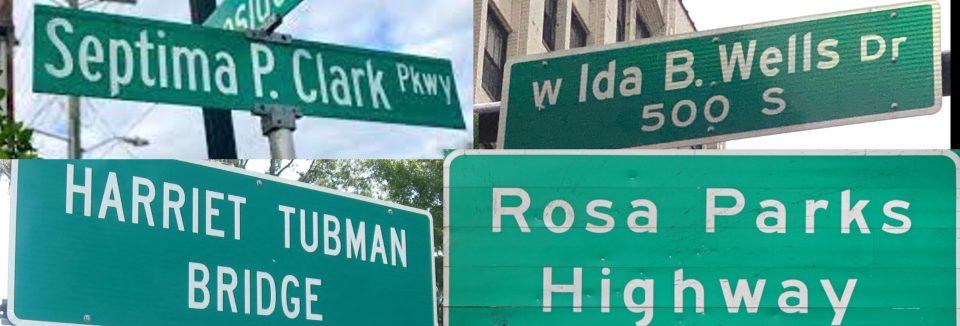
I am a co-founder of the Race, Ethnicity, and Social Equity in Tourism (RESET) Initiative (tourismreset.com)–co-coordinated by Stefanie Benjamin and Alana Dillette.
Overview
Tourism RESET is a multi-university and interdisciplinary research and outreach initiative that seeks to identify, study, and challenge patterns of social inequality in the tourism industry, historically and now, while also advancing our general understanding of the racialized politics of mobility, movement, and transportation in the United States and beyond. Special attention is focused on amplifying the role of racial and ethnic minoritized groups in tourism and travel development, recognizing the role these groups have long played in claiming and creating alternative spaces and communities/networks devoting to resistant hospitality and counter-mobility work. Little sustained work has been done on the preferences, characteristic, and challenges of minority travelers and there is a need to incorporate the natural and cultural heritage of racial and ethnic populations into tourism products available to the consuming public. In addition to being a convenient acronym, RESET captures the progressive nature of the initiative and the belief that tourism development, if done in sustainable and responsible ways, can be tools for racial reconciliation and minority empowerment- in effect pressing the “reset” button on the inequalities and insensitivity of the traditional tourism industry. Special attention is devoted on the racialized politics of travel, mobility, and hospitality, the African American freedom struggle, and the critique and reform of tourism in the southeastern United States. Education–both within formal classrooms but also the public pedagogy of industry engagement–is a key component of Tourism RESET.
RESET-Related External Funding
$445,423. “Transformation of Racialized American Southern Heritage Landscapes.” National Science Foundation, Geography and Spatial Sciences. Co-PI with David L. Butler, Candace Bright, Perry Carter, Stephen Hanna, Arnold Modlin, and Amy Potter, 2014-2018 (Research Grant).

Reconstructed Slave Cabins, Oak Alley Plantation, LA (photo by Arnold Modlin)
The objective of this research was to contribute to the theorization of the transformation of racialized southern heritage landscapes within the United States. Long dominated by white-centric conceptions of identity, social actors, and groups in the South have traditionally ignored, misrepresented, and trivialized African-American contributions and struggles within the region’s landscape iconography and tourism. This historical marginalization has been acutely evident at antebellum plantation tourism sites, which have been decidedly silent about the lives and struggles on the enslaved community. Recent evidence indicates southern heritage landscapes, including plantation sites, are increasingly bringing African-American struggles front and center within the representation of the history of the South and the United States. This transformation is a complex and sometimes dissonant process open to multiple and contradictory constructions and interpretations by plantation owners/managers, tour guides/docents, and the tourists/visitors themselves. The researchers examined and produced a sizable research number of articles, edited book chapters, a book (UGA Press) exploring the processes and politics of incorporating slavery into plantation landscapes, recognizing that these landscapes consist of built (material), textual (representational), and performative (bodily) aspects that can advance and significantly affect the production and consumption of public memories of the enslaved.
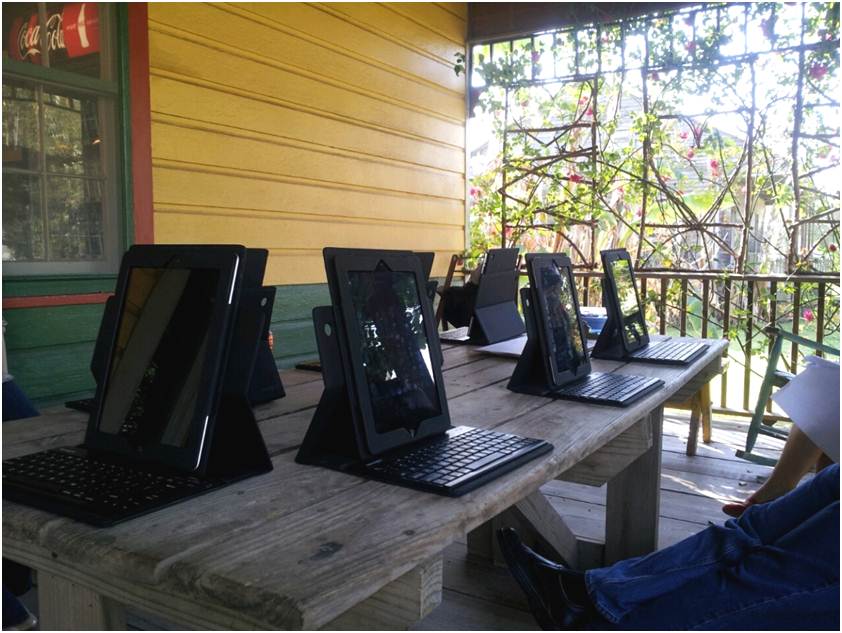
Plantation Visitor Survey Station, Laura Plantation, LA
Building upon a recent substantial pilot study, the research team will conduct extensive mixed-method field work, visiting several plantation sites in three major southern tourism regions (Louisiana, Georgia-South Carolina, and Virginia) to interview plantation owners/operators and docents, survey and interview tourists, and carry out participant observation and content analysis of guided tours of the plantation landscape. This research provides a lens into exploring the manner and extent to which southern plantations are moving toward an incorporation of the history of slavery into the memorial landscape of the nation and region, the factors motivating that incorporation of enslavement, and the role the landscape plays in narrating these traditionally marginalized histories.
$185,777 “The Role of Geographic Mobility in the African American Freedom Struggle.” Summer Seminars and Institutes for K-12 Educators, National Endowment for the Humanities. Awarded August 2020. Co-Director with Kurt Butefish & Joshua Kenna (Pedagogy Grant).
In July of 2022, the University of Tennessee, Tourism RESET, and the Tennessee Geographic Alliance hosted a three-week summer institute funded by the National Endowment for Humanities to allow eighteen K-12 educators from across the country to explore “The Role of Geographic Mobility in the African American Freedom Struggle.” 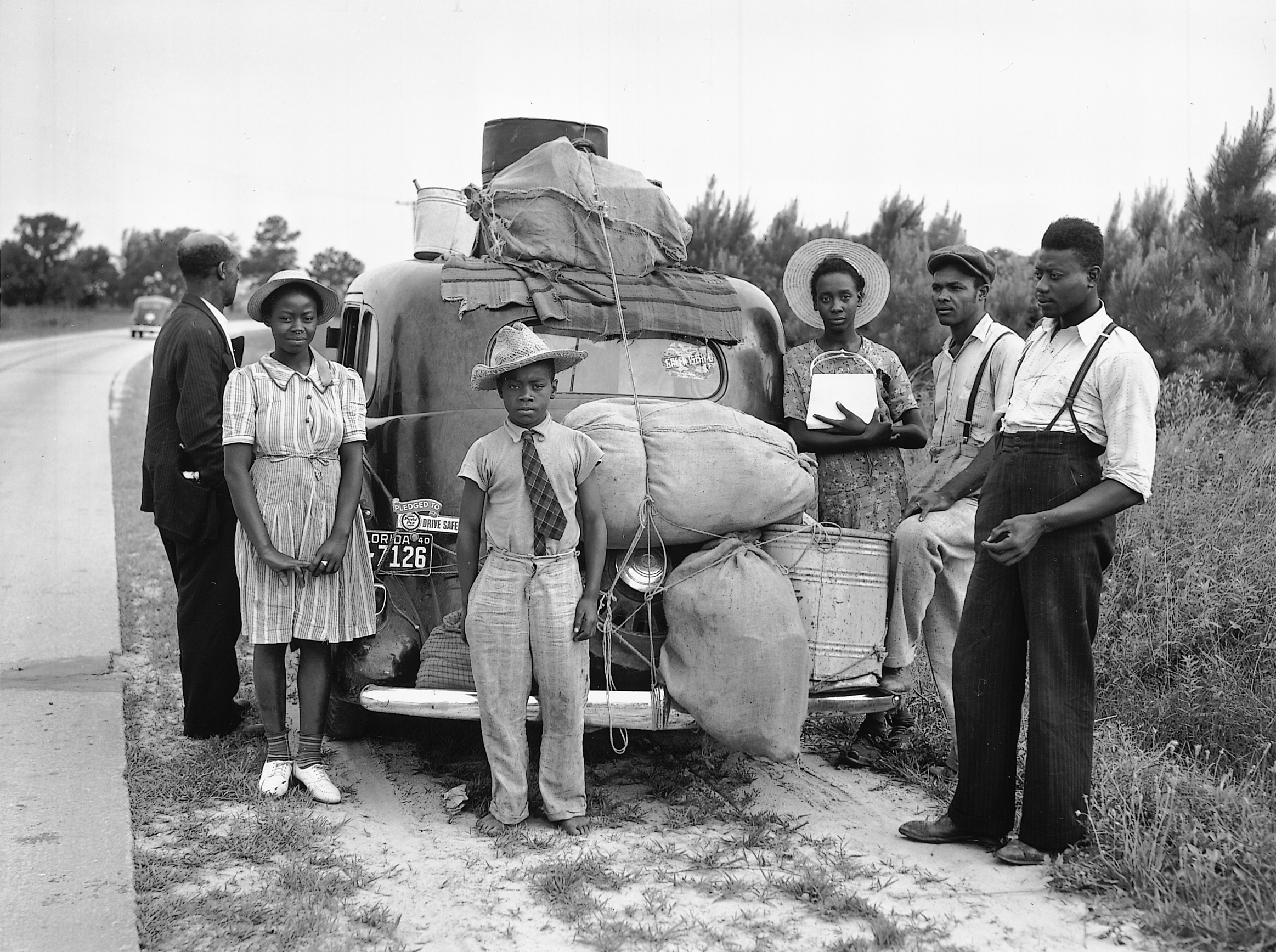 The institute focused on Movement as one of geography’s five fundamental themes and highlighted the central role of migration, transportation, and in particular travel and tourism played in maintaining structural racism and facilitating Black antiracist resistance, place-making and resiliency across multiple scales and historical periods-including the growing contemporary Black travel movement.
In support of studying the civil rights implications of geographic mobility, participating educators discussed assigned readings, podcasts, and documentary films; attended lectures and lab exercises; analyzed maps and archival resources; and learned about case studies, methodologies, and classroom  activities from curriculum and content experts. Engaging with the noted Negro Motorist Green Book–the Jim Crow era travel guide created by for and African Americans–was a major centerpiece of the NEH institute along with connecting a pedagogy of tourism to a critical understanding of the racialized history of geographic movement and mobility in the United States. The goal was not just to help educators acquire and apply content toward curricular standards, but also provide them moments to grapple with and overcome pedagogical, logistical, and political hurdles so that they can teach this content in their classrooms—especially given the increasingly charged rhetoric and policies surrounding teaching race in many school districts. The NEH summer institute modeled a place-based pedagogy and focused particular attention on African American civil rights and travel/mobility experiences in Tennessee. with educators undertaking a local Knoxville field trip and a three day excursion to Nashville and Memphis. The results of this workshop are published in a special issue of The Geography Teacher (published by National Council for Geographic Education).
RESET-Related Publications
- Alderman, Derek H. and Ethan Bottone.* (Forthcoming). “Racialized Mobility and Tourism Justice in America: The Green Book as Archive and Map.” Justice, Mobility & Power: In Search of Ethical Encounters in Tourism (edited by Dominic Lapointe, Bryan S. R. Grimwood, Meghan Muldoon, and Michela J. Stinson). Routledge.
- Bottone, Ethan, Derek H. Alderman, Stefanie Benjamin, and Sarah Frankel. 2024. “Atmospheric Instability in Dark Tourism: Spatial Construction of Conflicting Affective Atmospheres at the Titanic Museum & Attraction, Pigeon Forge, Tennessee (USA).” Dark Tourism Geographies: Critical Epistemologies on Death and Disaster (edited by Nitasha Sharma, Annaclaudia Martini & Dallen J. Timothy). De Gruyter. pp. 33-51
- Podcast summary of Chapter (Academia.edu)
- Hanna, Stephen, Amy Potter, and Derek H. Alderman. 2024. “Mapping Narratives on Historical Tours: A Mobile Method for Researchers and Practitioners.” The Routledge Handbook of Cartographic Humanities (edited by Tania Rossetto & Laura Lo Presti). Routledge. pp. 339-348
- Alderman, Derek H. and Ethan Bottone. 2024.“On Doing Justice to Black Mobility & Movement in the Classroom.” The Geography Teacher 21(1): 25-32. (for special issue “Teaching Black Geographies of Mobility”)
- Podcast summary of Article (Academia.edu)
- Alderman, Derek H., Ethan Bottone. Kurt Butefish, Joshua Kenna, and Katrina Stack. 2024. “An NEH Institute on Black Geographies of Mobility: Toward New Frameworks for Teaching Movement.” The Geography Teacher 21(1): 21-24. (for special issue “Teaching Black Geographies of Mobility”)
- Podcast summary of Article (Academia.edu)
- Stack, Katrina and Derek H. Alderman. 2024. “Tent City/Freedom City Geographies: Teaching Beyond the “Canon” of Civil Rights Movement Memory.” The Geography Teacher 21(1): 50-57. (for special issue “Teaching Black Geographies of Mobility”)
- Weigel, Amy, Joshua Kenna, and Derek H. Alderman 2024. “Changes and Consequences in Black Geographies of Mobility: The Rondo Neighborhood Story.” The Geography Teacher 21(1): 42-45. (for special issue “Teaching Black Geographies of Mobility”)
- Alderman, Derek H. and Joshua Inwood. 2023. “Recovering the Black Geographies of Motorsports: The Counter-Mobility Work of NASCAR’s Wendell Scott.” The History and Politics of Motor Racing: Lives in the Fast Lane. Palgrave Macmillan (edited by Damion Sturm, Stephen Wagg, and David L. Andrews), pp. 327-354
- Potter, Amy, Stephen Hanna, Derek H. Alderman, Perry Carter, Candace Bright, and David Butler. 2022. Remembering Enslavement: Reassembling the Southern Plantation Museum. University of Georgia Press.
- Hanna, Stephen, Derek H. Alderman, Amy Potter, Perry Carter, and Candace Bright. 2022. “A More Perfect Union? The Place of Black Lives in Presidential Plantation Sites.” Memory Studies 15(5): 1205-1231.
- Alderman, Derek H., Kortney Williams, and Ethan Bottone.* 2022. Jim Crow Journey Stories: African American Driving as Emotional Labor. Tourism Geographies 24 (2-3): 198-222. (special issue on affect and tourism)
- Alderman, Derek H. and Joshua Inwood. 2020. “Historical Geographies and Archived Subjects: Research as Doing Emotional Justice (to the Green Book).” Research Ethics for Human Geography: A Handbook for Students. SAGE (edited by Helen F. Wilson and Jonathan Darling), pp. 192-201.
- Cooper, Alex and Derek H. Alderman. 2020. “Cancelling March Madness Exposes Opportunity for More Sustainable Sports Tourism Economy.” Tourism Geographies 22(3): 525-525. (Editor-reviewed 5,100 commentary for special issue, “Reset: Travel and Tourism after the Global Transformation of 2020”).
- Benjamin, Stefanie, Dillette, Alana, and Derek H. Alderman. 2020. “’We Can’t Return to Normal’: Committing to Tourism Equity in the Post-Pandemic Age.’ Tourism Geographies 22(3): 476-483. (Editor-reviewed 2,700 word commentary for special issue, “Reset: Travel and Tourism after the Global Transformation of 2020”).
- Bright, Candace, Perry Carter, Stephen Hanna, Amy Potter, Arnold Modlin Jr., and Derek H. Alderman. 2020. “The Local Role of Southern Tourism Plantations in Defining a Larger Southern Regional Identity as Reflected in Tourists’ Surveys.” Geographical Review 110(3): 270–298.
- Modlin, E. Arnold, Stephen Hanna, Perry Carter, Amy Potter, Candace Forbes-Bright, Derek Alderman. 2018. “Can Plantation Museums Do Full Justice to the Story of the Enslaved? A Discussion of Problems, Possibilities, and the Place of Memory.” GeoHumanities 4(2): 335-359.
- Alderman, Derek H. 2018. “The Racialized and Violent Biopolitics of Mobility in the USA: An Agenda for Tourism Geographies.” Tourism Geographies 20(4): 717-720. (invited editorial to mark 20th anniversary of journal).
- Hanna, Stephen, Perry Carter, Amy Potter, Candace Bright, Derek H. Alderman, E Arnold Modlin, David L. Butler. 2018. “Following the Story: Narrative Mapping as Mobile Method for Tracking and Interrogating Spatial Narratives,” Journal of Heritage Tourism 14(1): 49-66. Recipient of Zumkehr Prize in Public Memory Scholarship.
- Benjamin, Stefanie and Derek H. Alderman. 2018. “Performing a Different Narrative: Museum Theater and the Memory-Work of Producing and Managing Slavery Heritage at Southern Plantation Museums.” International Journal of Heritage Studies 24(3): 270-282.
- Hanna, Stephen P. Derek H. Alderman, and Candace Bright. 2018. “From Celebratory Landscapes to Dark Tourism Sites? Exploring the Design of Southern Plantation Museums.” The Palgrave MacMillian Handbook of Dark Tourism Studies (edited by Philip Stone lead editor, with Rudi Hartmann, Tony Seaton, Richard Sharpley, Leanne White), pp. 399-421.
- Alderman, Derek H. and Caspersen, Janna. 2018. “Barbecue Tourism: The Racial Politics of Belonging within the Cult of the Pig.” Tourism Experiences & Animal Consumption: Contested Values, Morality, & Ethics. (edited by Carol Kline), pp. 102-118.
- Bright, Candace Forbes, Derek H. Alderman, David L. Butler. 2018. “Tourist Plantation Owners and Slavery: A Complex Relationship.” Current Issues in Tourism 21(15): 1743–1760.
- Benjamin, Stefanie, Carol Kline, Derek H. Alderman, and Wilson Hoggard. 2016. “Heritage Site Visitation and Attitudes Toward African-American Heritage Preservation: An Investigation of North Carolina Residents.” Journal of Travel Research 55(7): 919-933.
- Alderman, Derek H., David L. Butler, and Stephen P. Hanna. 2016. “Memory, Slavery, and Plantation Museums: The River Road Project.” Journal of Heritage Tourism 11(3): 209-218. (Non-refereed introduction to special thematic issue guest edited by author, David L. Butler, and Stephen Hanna).
- Alderman, Derek H., and E. Arnold Modlin Jr. 2016. “On the Political Utterances of Plantation Tourists: Vocalizing the Memory of Slavery on River Road.” Journal of Heritage Tourism 11(3): 275-289. (Special issue on slavery and plantation tourism guest edited by author, David L. Butler, and Stephen Hanna).
- Alderman, Derek H. and Joshua Inwood. 2016. “Mobility as Anti-Racism Work: The ‘Hard Driving’ of NASCAR’s Wendell Scott.” Annals of the Association of American Geographers 106(3): 597–611.
- Inwood, Joshua F.J., Derek H. Alderman, and Jill E. Williams. 2015. “’Where Do We Go From Here?’ Transportation Justice and the Continuing Struggle for Public Access.” Southeastern Geographer 55(4): 417-433.
- Alderman, Derek H. and Joshua Inwood. 2014. “Toward a Pedagogy of Jim Crow: A Critical Reading of The Green Book.” Teaching Ethnic Geography in the 21st Century, National Council for Geographic Education (edited by Lawrence Estaville, Edris Montalvo, and Fenda Akiwumi), pp. 68-78.
- Carter, Perry, David Butler, and Derek H. Alderman. 2014. “The House that Story Built: The Place of Slavery in Plantation Museum Narratives.” Professional Geographer 66(4): 547–557.
- Hao, Huili, Derek H. Alderman, Patrick Long. 2014. “Homeowners’ Attitudes toward Tourism in a Mountain Resort Community: A Comparison of Seasonal and Permanent Property Owners.” Tourism Geographies 16(2): 270-287.
- Kline, Carol, Hao Hao, Derek H. Alderman, Jim Kleckley, and Scott Gray. 2014. “A Spatial Analysis of Tourism, Entrepreneurship and Entrepreneurial Ecosystems in North Carolina, U.S.A.” Tourism Planning & Development 11(3): 305-316.
- Alderman, Derek H. 2013. “African Americans and Tourism.” Tourism Geographies 15(3): 375-379. Non-refereed introduction to special thematic issue guest organized by author and Selima Sultana.
- Alderman, Derek H. and Arnold Modlin, Jr. 2013. “Southern Hospitality and the Politics of African American Belonging: An Analysis of Photographs in North Carolina Tourism Brochures.” Journal of Cultural Geography, 30(1): 6-31.
- Alderman, Derek H. 2013. “’History by the Spoonful’ in North Carolina: The Textual Politics of State Highway Historical Markers.” Southeastern Geographer, 52(4): 355-373.
- Benjamin, Stefanie K., Paige P. Schneider, and Derek H. Alderman. 2012. “Film Tourism Event Longevity: Lost in Mayberry.” Tourism Review International 16: 139-150.
- Alderman, Derek H., Stefanie Benjamin*, and Paige P. Schneider. 2012. “Transforming Mount Airy into Mayberry: Film-Induced Tourism as Place-Making.” Southeastern Geographer 52(2): 212-239.
- Alderman, Derek H. and G. Rebecca Dobbs. 2011. “Geographies of Slavery: Of Theory, Method, and Intervention.” Historical Geography 39: 29-40.
- Modlin, E. Arnold Jr., Derek H. Alderman, and Glenn W. Gentry. 2011. “Tour Guides as Creators of Empathy: The Role of Affective Inequality in Marginalizing the Enslaved at Plantation House Museums.” Tourist Studies 11(1): 3-19.
- Alderman, Derek H. 2010. “Surrogation and the Politics of Remembering Slavery in Savannah, Georgia.” Journal of Historical Geography 36: 90-101.
- Alderman, Derek H., and E. Arnold Modlin, Jr. 2008. “(In)Visibility of the Enslaved within Online Plantation Tourism Marketing: A Textual Analysis of North Carolina Websites.” Journal of Travel and Tourism Marketing 25(3-4): 265-281.
- Alderman, Derek H. and Rachel Campbell*. 2008. “Symbolic Excavation and the Artifact Politics of Remembering Slavery in the American South: Observations from Walterboro, South Carolina.” Southeastern Geographer 48(3): 338-355. Contribution to special issue “Museums, Narratives, and the Contested Memory of Slavery” (guest edited by Derek Alderman and E. Arnold Modlin Jr.).
 Derek H. Alderman